Services Custom AI Systems
If the system you need doesn't exist, we build it.
We design custom AI agents, assistants and intelligent systems around the way your business actually works.
Built around you. Not the other way round.
- Your data
- Your tools
- Your rules
- Your team
Start with the problem.
We don't start by asking where to put AI.
We start with the problem. Then we work out whether AI is actually the answer.
Sometimes the right solution is an AI agent. Sometimes it's automation. Sometimes it's better software. Often it's a combination, and we tell you which before anything gets built.
Already have a process that runs the same way every time? That is Business Process Automation. This page is for the capability your business doesn't have yet.
- What is taking too long?
- What information is hard to get to?
- What needs too many people?
- Which decision keeps repeating?
- Where does information get stuck?
- What do you wish your software could do?
An agent is AI that can do something with the answer.
A chatbot tells you what the customer wants. An agent checks the calendar, makes the change, updates the record, sends the confirmation, and knows when to ask.
The answer is useful. The action is more useful.
Hi, can we move Thursday's appointment to next week? Same time if you can. Also, is the deposit refundable?
Your customer has asked to move Thursday's appointment to next week and has a question about the deposit.
Now somebody has to go and do it.
- CheckedAvailability next week, same time
- MovedAppointment to Tuesday at the same time
- UpdatedThe customer record and the crew's schedule
- SentA confirmation with the new date
- AskedThe deposit question is a policy exception. It went to the office manager with the customer's message attached.

Give your team a way to ask the business.
An assistant that knows your operation, because it reads the approved sources your business already keeps, and shows where every answer came from.
An example, for a commercial contractor. The names and details are invented.
What changed on the Riverside project this week?
- CRM
- Files
- Calendar
- CRMChange order for the loading dock approved. Contract value updated.
- EmailTwo messages from the client about the inspection date.
- FilesRevised structural drawings uploaded on Wednesday.
- CalendarInspection moved to next Friday.
- OpenThe electrical sub has not confirmed the new date.
Make a summary for Monday's meeting.
Draft ready. Six points, each linked to where it came from.
Draft. Waiting for the project manager to review.Other things a team asks
- "How do we handle this type of customer?"
- "Where is the latest pricing sheet?"
- "What tasks are still open on the Hale job?"
- "What does our policy say about deposits?"
The jobs people bring us.
Different problems, one method: what the system needs to know, what it may do, and who signs off.
Research every account before a rep calls.
- InThe prospect and their CRM record
- SystemA research agent with your sales knowledge
- OutAn account brief: what they do, the history, likely needs, the questions to ask
Ask what is happening across jobs and systems.
- InEvents from the CRM, the calendar, the task board
- SystemCoordinated agents, each with a defined job
- OutTasks created, decisions routed, exceptions sent to a person
Let employees search company information by asking.
- InDocuments, procedures, records, past work
- SystemA knowledge assistant with permissions per role
- OutAnswers with sources, in the tools the team already uses
Turn incoming files into structured work.
- InForms, PDFs, contracts, photos, email attachments
- SystemDocument reading and vision, with a reviewer for the uncertain ones
- OutExtracted, sorted, summarised, routed, and the record updated
Build a customer-facing tool specific to the business.
- InWhat your customers keep asking for
- SystemAn assistant or portal built on your own information
- OutCustomers help themselves; the odd case goes to your team
Give AI permission. Not unlimited permission.
Autonomous doesn't mean unsupervised. Before we build, we write down what the system may do on its own, what it has to ask about, and what stays with a person.
AI can
- Read approved data
- Draft a reply or a document
- Update a routine record
- Trigger an approved workflow
AI must ask
- A large financial action
- A sensitive exception
- An unusual customer situation
- Anything outside policy
A person
- Reviews
- Approves
- Overrides
- Takes over
Use AI where AI is useful.
AI is good at
- Repetitive analysis
- Finding information
- Drafting
- Routing
- Sorting and summarising
- Watching for defined signals
- Running defined workflows
People are good at
- Judgment
- Relationships
- Negotiation
- Exceptions
- Leadership
- Creative direction
- Sensitive decisions
The system only gets access to what it needs. Approved sources, defined actions, a log of what it did, and boundaries written down before it goes live.

You probably don't need to replace anything.
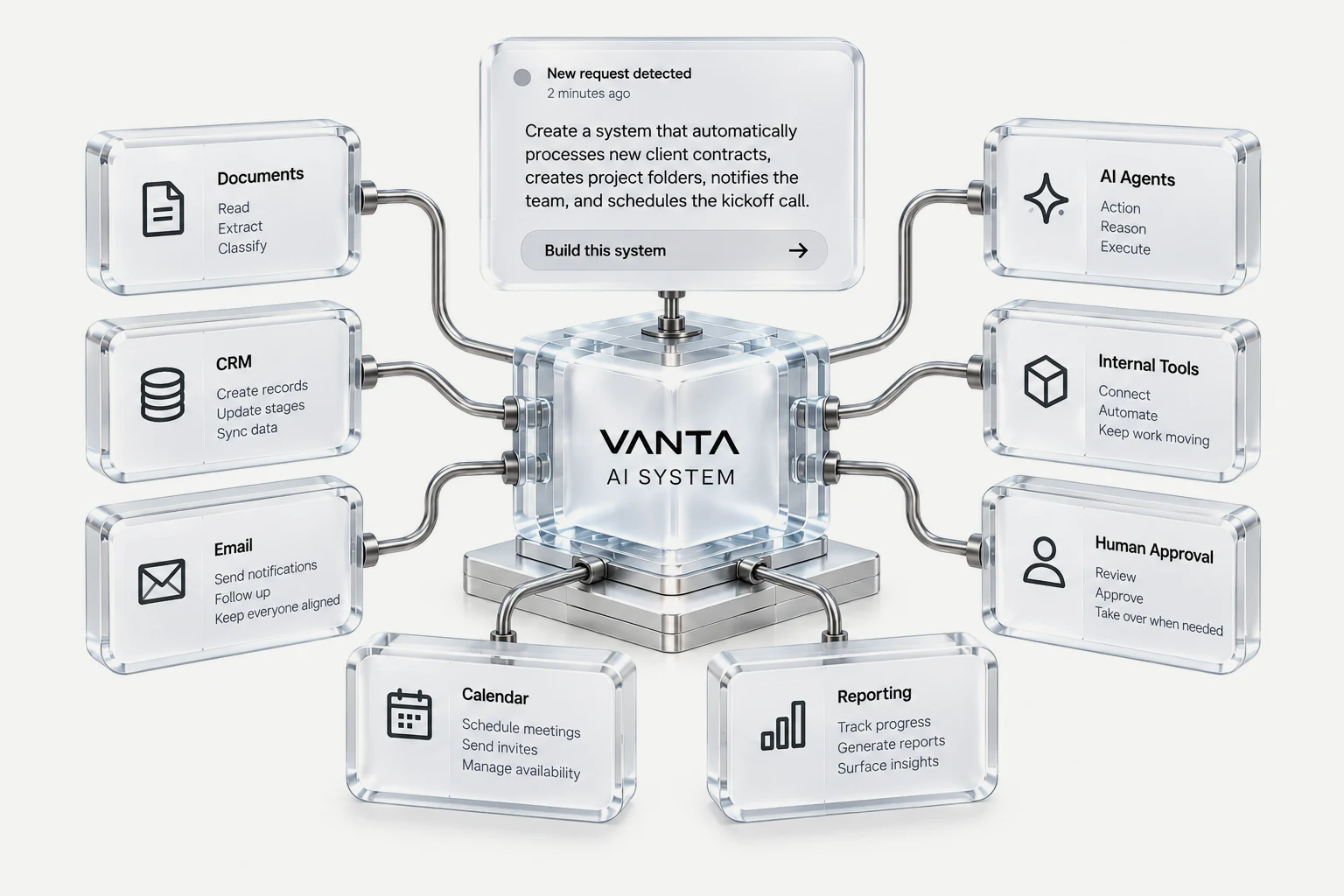
Custom AI usually works best as a layer across the systems your company already relies on, with an interface where your team already works.
Where your team uses it
- Dashboard
- Search
- Client portal
- Embedded assistant
- Internal tool
- Reports
Reads. Reasons. Drafts. Routes. Updates. Asks when it should.
What you already run
- CRM
- Calendar
- Files
- Phone
- Website
- Accounting
- Your own software
It connects to what you have.
- CRMHubSpot, Salesforce, GoHighLevel
- Email and calendarGoogle Workspace, Microsoft 365
- Files and recordsGoogle Drive, Notion, Airtable, databases
- Phone and messagingTwilio, Slack
- Field and moneyJobber, Housecall Pro, ServiceTitan, QuickBooks, Stripe
- Your own softwareAnything with an API
We can connect with many common business platforms and APIs depending on your existing stack and requirements. These are examples of what we have worked with, not partnerships, and not every connection is out of the box. We tell you which before we start.
We can build the interface too.
Not every system should live in a chat box. If your team needs a dashboard, a search page, a client portal, or a tool that sits inside the software they already open every morning, we design and build that as well.
It is the same team that builds our websites, so the interface gets the same care as the system underneath it.
How we design a system.
Six steps. The first one has nothing to do with AI.
- 01
We understand the problem.
Not "what AI do you want?" but "what needs to work better?"
- 02
We map the information.
What does the system need to know? Where does that information live today?
- 03
We define what AI may do.
Read. Reason. Draft. Route. Update. Trigger. Ask for approval. Each one decided, not assumed.
- 04
We connect the tools.
Your CRM, your documents, your databases, your business software, through their APIs.
- 05
We build it and test it.
Normal cases. Edge cases. Permissions. Failures. The handoff to a person.
- 06
We launch it, then improve it.
We watch what it does, refine it, and expand it when the first part is earning its keep.
Questions people ask before they book the call.
What is a custom AI system?
A capability built around your business rather than bought off a shelf. It might be an assistant that knows your operation, an agent that researches or acts, a system that reads documents or photos, or several of those working together, connected to the software you already use.
How is this different from process automation?
Automation takes a process that already runs the same way every time and makes it run itself. A custom system gives the business a capability it does not have yet, usually one that needs judgment, knowledge or reasoning in the middle. Plenty of projects use both, and we tell you which you need on the first call.
What is an AI agent?
AI that can do something with the answer. A chatbot tells you the customer wants to move an appointment. An agent checks the calendar, moves it, updates the record, sends the confirmation, and knows which cases to hand to a person.
Can it use information specific to my company?
Yes, and it usually has to. Documents, procedures, CRM records, product details, policies, databases, approved web content. We agree which sources are in, and the system answers from those, with the source shown, rather than from general knowledge.
Can it connect to my CRM and my other software?
Most likely. We have worked with the common platforms and with plenty of unusual ones, and anything with an API is usually reachable. We confirm your specific tools before we start and say plainly if one of them needs custom work.
Can it search our internal documents?
Yes. That is one of the most common systems we build: an assistant your team can ask, which reads the approved documents, respects who is allowed to see what, and shows where each answer came from.
Can you build multi-agent systems?
Yes, when the job calls for it. Several agents with one job each, coordinating, is a good fit for operations that span many systems. Each agent gets only the tools and permissions its job needs. Nothing gets unlimited access because it is called an agent.
Can it work with PDFs and photos?
Yes. Forms, contracts, invoices, applications, site photos, inspection images, receipts. It reads what is there, pulls out the details that matter, routes the file to the right place, then updates the record. Where the reading is uncertain, or the stakes are high, it flags the item to a person instead of guessing.
Can it take actions inside other systems?
Yes, within limits you set. Updating a record, creating a task, sending a confirmation, triggering a workflow. Which actions it may take on its own, which need a yes, and which it may never take are written down before it goes live.
How do you stop it doing things it should not?
By design, not by hope. It only sees approved sources. It only has the actions we gave it. Sensitive or unusual cases wait for a person. Everything it does is logged. And we test the failure cases before launch, not after.
Do we need to replace our existing software?
Usually not. Most custom systems work as a layer across what you already have. If something you rely on genuinely cannot be connected, we tell you before we start and talk through the options.
How long does it take, and what does it cost?
It depends on what the system needs to know, how many tools it touches, and how much needs a person in the loop. We scope it with you on the first call and give you both numbers, build and monthly, out loud. The first working piece usually arrives in weeks, not months.
Tell us what you wish your business could do.
You don't need to know what AI to build. Just tell us what needs to work better. If it can be solved with software, automation or AI, we'll help you find the right system.